
Platelet Disorders

Platelet Disorders (Low Platelet Count & ITP)
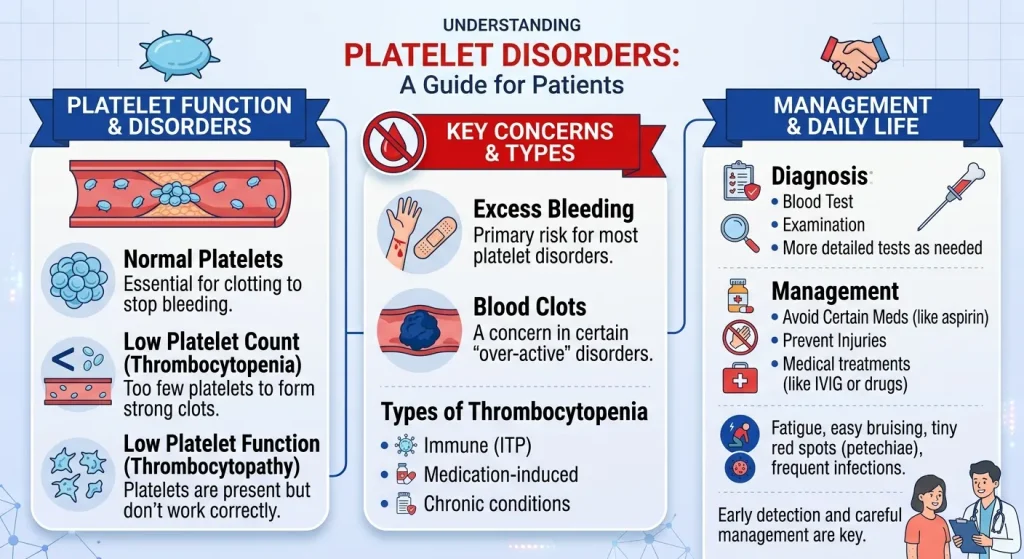
Platelets (thrombocytes) are specialized blood cells produced in the bone marrow that play a critical role in blood clotting. When blood vessels are injured, platelets clump together to form a plug and stop bleeding. A disruption in platelet numbers or function—most commonly a low platelet count, known as thrombocytopenia—impairs the body’s natural clotting mechanisms and leads to abnormal bleeding or bruising.
What the Conditions Are
Platelet disorders primary involve deficiencies in platelet counts or function:
Low Platelet Count (Thrombocytopenia): A condition characterized by a abnormally low level of platelets in the blood (typically below $150,000\text{ per microliter}$). It can range from mild, asymptomatic levels to severe deficiencies that pose risks of spontaneous bleeding.
Immune Thrombocytopenia (ITP): An autoimmune platelet disorder where the body’s immune system mistakenly produces autoantibodies that target and destroy its own platelets, primarily in the spleen. It can occur as an acute, self-limiting condition (common in children post-viral infection) or as a primary chronic condition in adults.
Common Symptoms
Because platelets control clotting, symptoms primarily present as bleeding manifestations across the skin and mucous membranes:
| Category | Warning Signs & Symptoms |
|---|---|
|
Skin Signs |
Tiny, pinpoint red or purple spots on the lower legs (petechiae); large, unexplained bruises (purpura or ecchymosis) appearing from minor impact. |
|
Mucosal Bleeding |
Frequent, hard-to-stop nosebleeds (epistaxis); bleeding gums during routine brushing; blood in urine or stool. |
|
Systemic Manifestations |
Unusually heavy or prolonged menstrual bleeding (menorrhagia); persistent fatigue; prolonged bleeding from minor cuts. |
Possible Causes & Risk Factors
Thrombocytopenia occurs through three primary mechanisms: decreased platelet production, increased platelet destruction, or splenic sequestration.
- Autoimmune Destruction (ITP): Malfunctioning immune antibodies labeling platelets for premature destruction in the spleen.
- Bone Marrow Suppression: Chemotherapy, viral infections (e.g., Dengue, Hepatitis, HIV), or marrow failure disorders reducing platelet manufacturing.
- Splenic Sequestration: An enlarged spleen (splenomegaly) trapping and holding an abnormally high percentage of platelets, keeping them out of circulation.
- Medication-Induced: Side effects from specific drugs, including heparin, anticonvulsants, and certain antibiotics.
When to Consult a Hematologist
You should seek a specialist evaluation with a hematologist if you experience:
- A routine blood test showing a platelet count consistently below 100,000/uL.
- Spontaneous, unexplained bruising or petechiae spreading across your body.
- Recurrent, severe nosebleeds or mucosal bleeding that takes extended time to clot.
- A sudden drop in platelet counts following a viral illness or starting new medications.
How Platelet Disorders Are Diagnosed
A complete diagnostic workup identifies whether low platelets are caused by an isolated immune response or an underlying bone marrow condition:
- Complete Blood Count (CBC) & Automated Platelet Count: Measures exact platelet concentrations in the bloodstream.
- Peripheral Blood Smear: Examines platelet size and morphology under a microscope to rule out false low readings caused by platelet clumping (pseudothrombocytopenia).
- Coagulation & Autoimmune Panels: Tests PT, aPTT, fibrinogen, and autoimmune markers to evaluate broader clotting pathways.
- Viral & Secondary Screening: Checks for underlying triggers like Dengue, Hepatitis C, HIV, or H. pylori infections.
- Bone Marrow Aspiration & Biopsy: Performed if diagnosis is uncertain or to rule out marrow failure disorders and leukemias by assessing megakaryocytes (platelet parent cells).
Available Treatment Approaches
Treatment depends on the severity of thrombocytopenia and the presence of active bleeding:
- Observation & Monitoring: Mild cases of thrombocytopenia or asymptomatic ITP without active bleeding often require only regular blood count monitoring.
- First-Line Medical Therapies: Corticosteroids (e.g., prednisone) or Intravenous Immunoglobulin (IVIG) to suppress immune destruction and rapidly raise platelet levels in ITP.
- Second-Line Therapies (TPO Receptor Agonists): Medications (such as Eltrombopag or Romiplostim) that stimulate the bone marrow to manufacture more platelets.
- Platelet Transfusions: Emergency administration of donor platelets for severe, active bleeding episodes or prior to urgent surgical procedures.
- Splenectomy: Surgical removal of the spleen, considered in persistent or refractory chronic ITP to stop the primary site of platelet destruction.
FAQs
Can a low platelet count cause internal bleeding?
Spontaneous internal bleeding is rare unless platelet counts drop dangerously low (typically below 10,000 to 20, 000/uL. A hematologist monitors these levels closely to prevent severe complications.
Is ITP a form of blood cancer?
No. ITP is an autoimmune condition, not a cancer. It does not spread to other organs, though it requires specialized management to maintain safe platelet levels.
Are there dietary changes that can increase my platelet count?
While a healthy diet supports overall blood cell production, dietary changes alone cannot correct autoimmune platelet destruction like ITP. Medical therapy prescribed by a doctor is necessary to manage low counts effectively.
Our Services
Get an Appointment
Schedule your expert consultation with Dr. Nitin Chaudhary today.